
Mechanism of Ag+-Induced Folding of a Bacterial Peptide from Replica-Exchange Molecular Simulations
Published in The Journal of Physical Chemistry Letters, 2026
Florian E. C. Blanc (corr.), Maggy Hologne, Marion Girod, Mélodie Demontrond☉, Henry Chermette, Olivier Walker (corr.)
The Journal of Physical Chemistry Letters, 2026
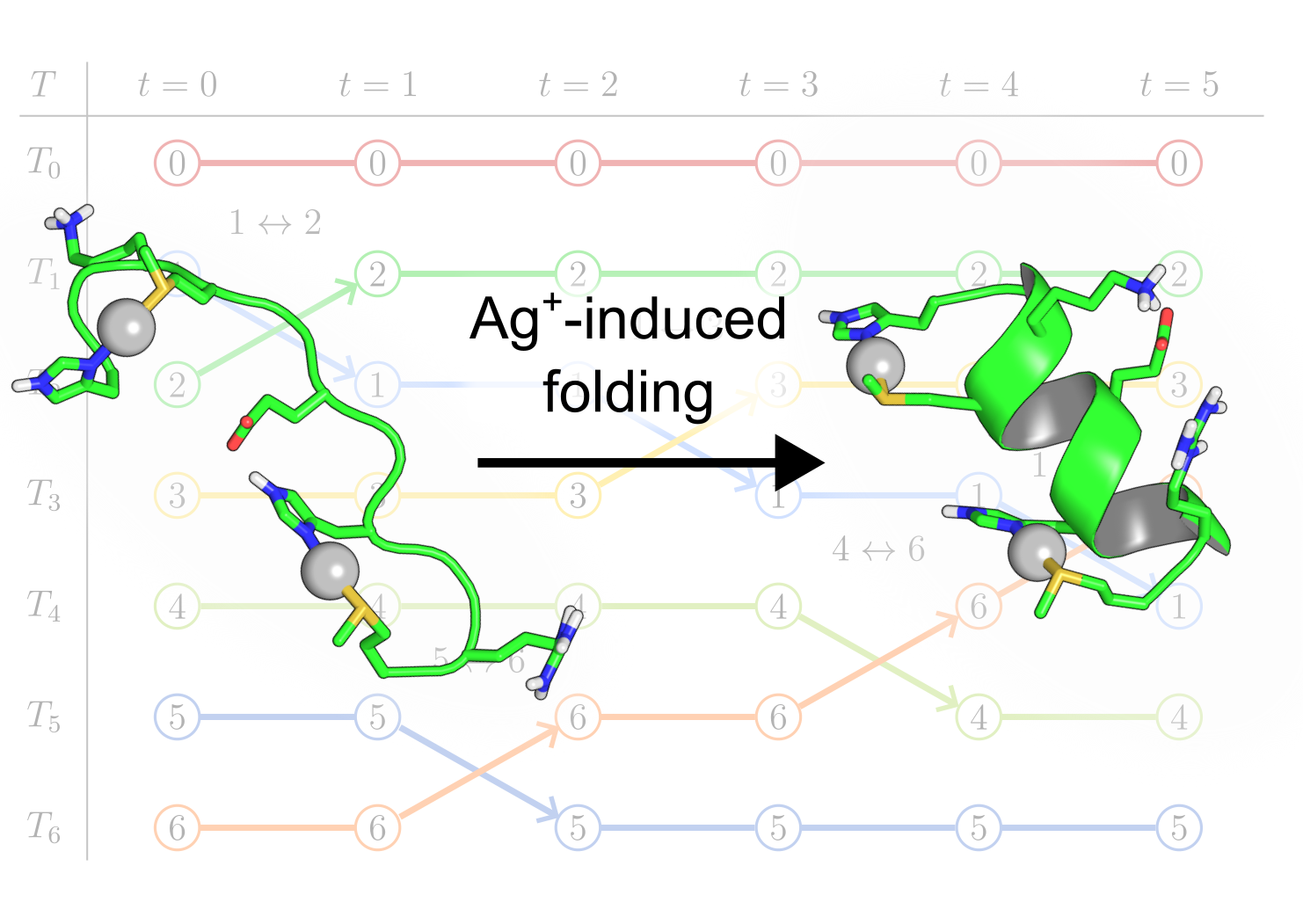
We use a custom bonded model and replica-exchange simulations to look at how Ag+ binding promotes the folding of an 11-residue peptide into an $\alpha$-helix. We train an autoencoder neural network to map the folding landscape. There is even some NMR and Mass Spec in there.
Abstract
Interactions between proteins and metal cations are central to biochemical processes and shape protein structures. SilE, an intrinsically disordered protein involved in bacterial silver resistance, folds into $\alpha$-helices upon binding Ag+ ions. Focusing on the B1 peptide fragment from SilE, we investigate the mechanism of Ag+-induced folding with atomistic simulations and experiments. Guided by Mass Spectrometry and NMR, we prepare a structural model of Ag+-bound B1, which we parametrize using DFT. Then, with replica-exchange simulations and deep learning, we map B1's folding landscape and how it is shaped by Ag+. Specifically, Ag+ binding promotes folding by lowering the entropy of the disordered state and stabilizing the folded state. We also describe how Ag+ alters the folding pathways. Overall, we improve our understanding of metal-induced protein folding and lay the groundwork for further computational investigations of the bacterial silver-resistance machinery.