
Publications
☉ Trainee under my supervision
Metadynamics Simulations Meet Ligand Design for the Reversible Inhibition of Human Peroxiredoxin 5
ACS Omega, 2026
In this drug design project, we combine funnel metadynamics, NMR and biochemical assays to improve an inhbitor of Human peroxiredoxin 5, a target enzyme for innovative treatments against strokes.
Mechanism of Ag+-Induced Folding of a Bacterial Peptide from Replica-Exchange Molecular Simulations
The Journal of Physical Chemistry Letters, 2026
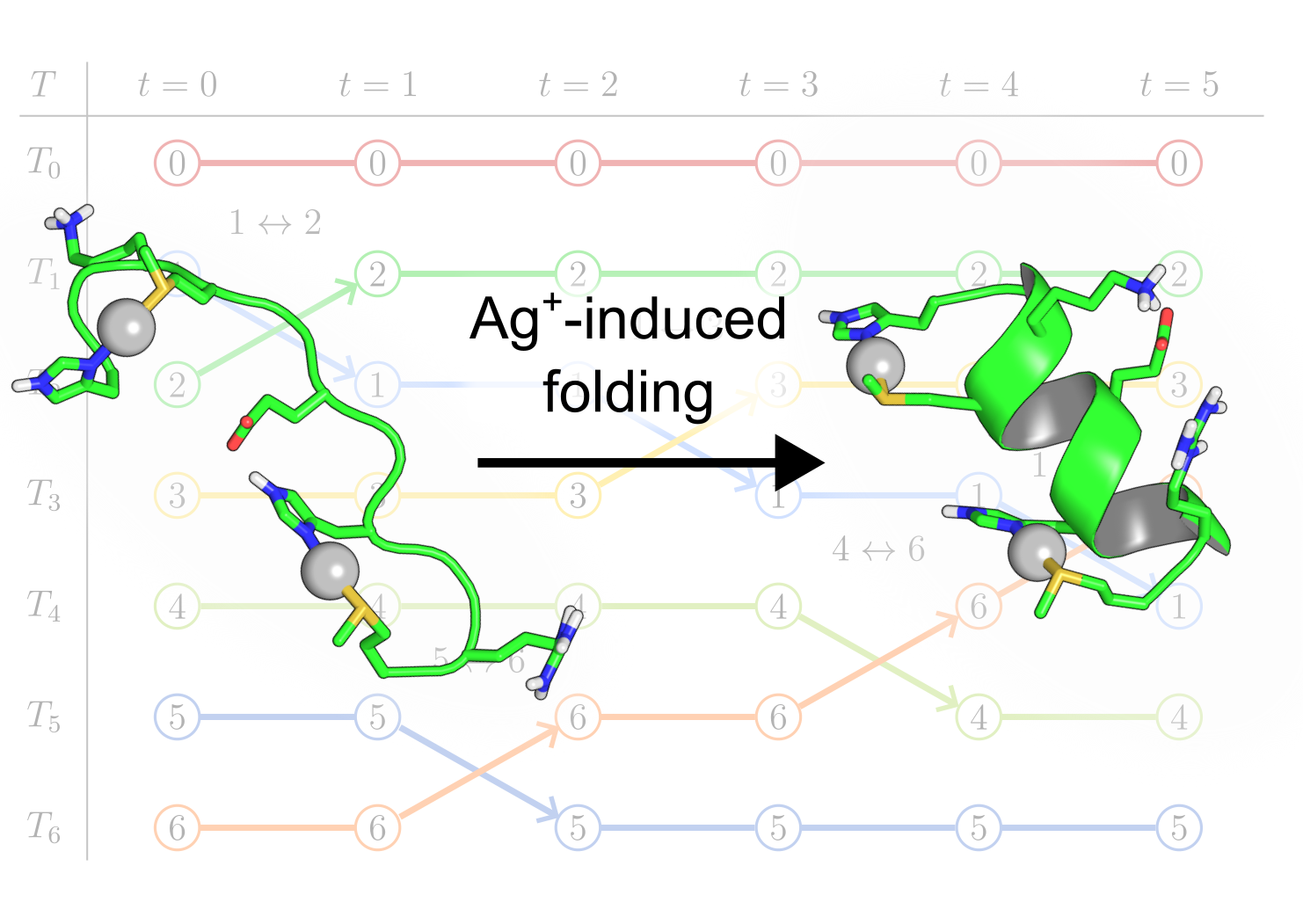
We use a custom bonded model and replica-exchange simulations to look at how Ag+ binding promotes the folding of an 11-residue peptide into an $\alpha$-helix. We train an autoencoder neural network to map the folding landscape. There is even some NMR and Mass Spec in there.
A Weak Coupling Mechanism for the Early Steps of the Recovery Stroke of Myosin VI: A Free Energy Simulation and String Method Analysis
PLOS Computational Biology, 2024
With eABF and the string method, we find that the recovery stroke of myosin VI is initiated by lever-arm re-priming with only weak coupling to ATPase activation.
Mechanism of Proton-Powered c-Ring Rotation in a Mitochondrial ATP Synthase
Proceedings of the National Academy of Sciences, 2024
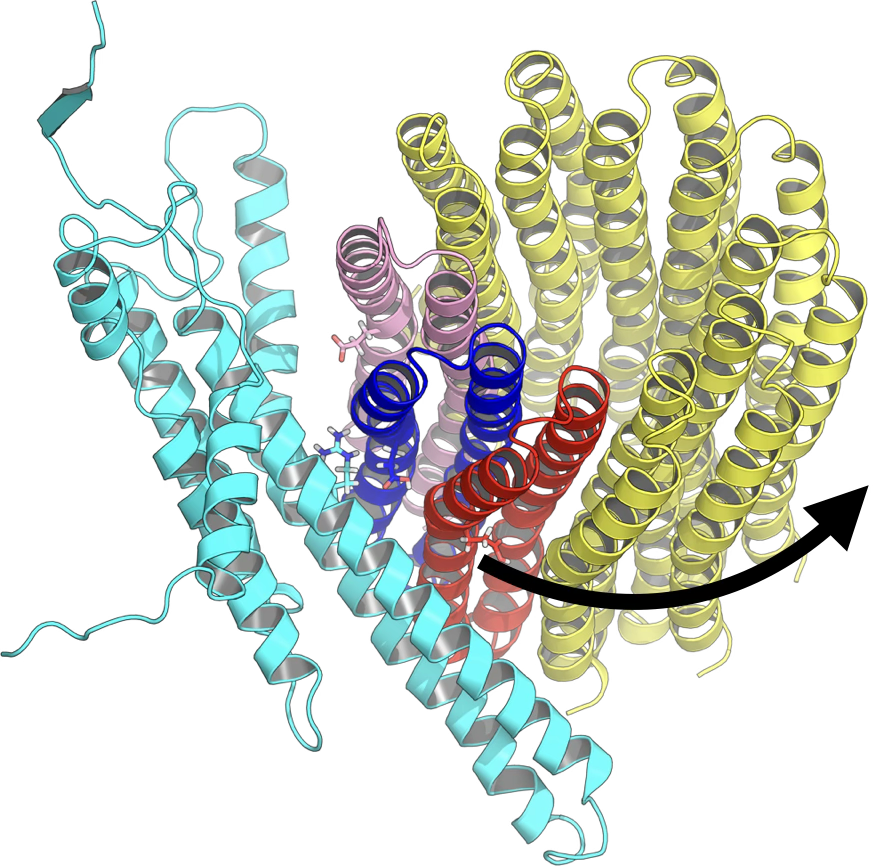
With extensive eABF calculations, we reveal the mechanism of the 36 deg rotation step of the ATP synthase rotor, clarifying the water-mediated proton transfer pathway and the role of experimentally-detected intermediates.
Molecular Mechanisms of Inorganic-Phosphate Release from the Core and Barbed End of Actin Filaments
Nature Structural & Molecular Biology, 2023
We combine cryo-EM, enhanced sampling MD simulations, machine learning, and in vivo and in vitro reconstitution to reveal the mechanisms and pathways for Pi release from F-actin, both from filament interior and barbed end.
Antibody Accessibility Determines Location of Spike Surface Mutations in SARS-CoV-2 Variants
PLOS Computational Biology, 2023
Using data from the early days of the pandemic, we show that surface accessibility to antibodies -estimated using a simple computational protocol- is a predictor of mutation sites found in later variants of concern.
We build one of the first complete models of the SARS-CoV-2 spike protein, simulate a viral membrane patch with 4 spike copies for 2.5 microseconds, and devise a machine learning approach to predict immunogenic sites from the simulation.
An Asymmetric Mechanism in a Symmetric Molecular Machine
The Journal of Physical Chemistry Letters, 2021
We combine ABF and the string method to look at how a synthetic molecular muscle contracts, and show that an asymmetric pathway in which subunits bend and rearrange sequentially dominates despite the symmetry of the supra-molecule.
In Situ Structural Analysis of SARS-CoV-2 Spike Reveals Flexibility Mediated by Three Hinges
Science, 2020
In situ cryo-ET and molecular modelling reveal the hinges of the SARS-CoV-2 a few months into the pandemic.
An Intermediate Along the Recovery Stroke of Myosin VI Revealed by X-Ray Crystallography and Molecular Dynamics
Proceedings of the National Academy of Sciences, 2018
With crystallography, conventional MD and ABF, we characterise a structural state of the myosin motor domain that suggests a “ratchet-like” mechanism in which lever-arm repriming precedes active site closure and is not strongly coupled to it.
Crystallography, single-molecule studies and implicit solvent simulations reveal how myosin X is optimised to walk fast on F-actin bundles.
Myosin MyTH4-FERM Structures Highlight Important Principles of Convergent Evolution
Proceedings of the National Academy of Sciences, 2016
Crystallography, binding affinity assays and MD simulations reveal “molecular tinkering” at play in the evolution of microtubule-binding domains in myosin tails.