
Mechanism of Proton-Powered c-Ring Rotation in a Mitochondrial ATP Synthase
Published in Proceedings of the National Academy of Sciences, 2024
Florian E. C. Blanc, Gerhard Hummer
Proceedings of the National Academy of Sciences, 2024
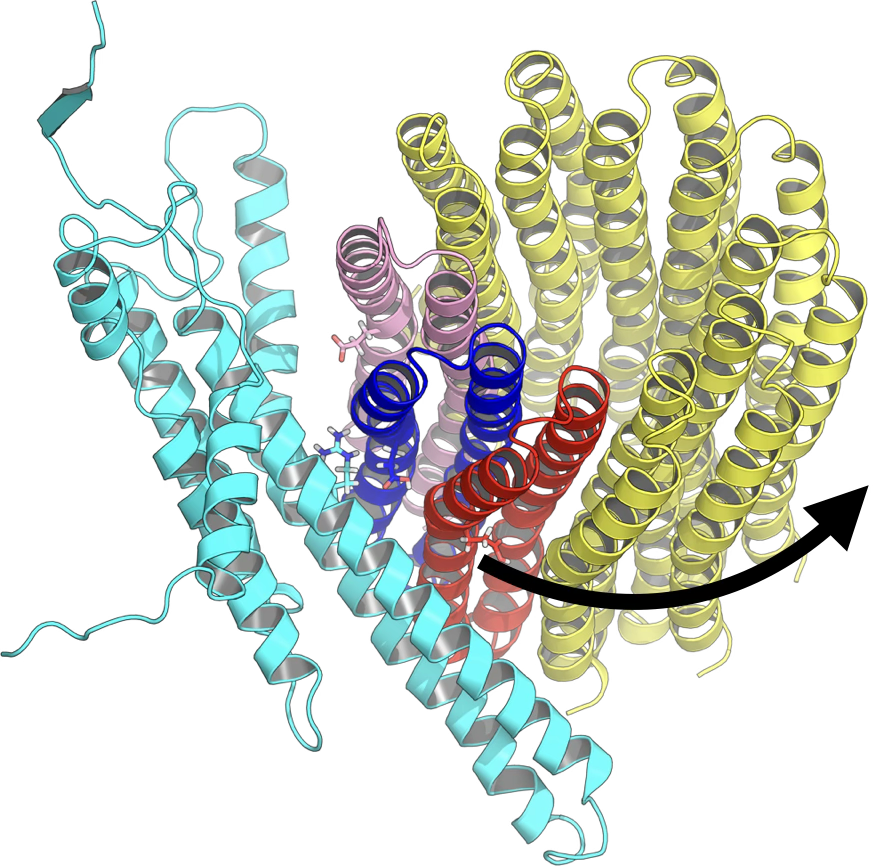
With extensive eABF calculations, we reveal the mechanism of the 36 deg rotation step of the ATP synthase rotor, clarifying the water-mediated proton transfer pathway and the role of experimentally-detected intermediates.
Abstract
Proton-powered c-ring rotation in mitochondrial ATP synthase is crucial to convert the transmembrane protonmotive force into torque to drive the synthesis of adenosine triphosphate (ATP). Capitalizing on recent cryo-EM structures, we aim at a structural and energetic understanding of how functional directional rotation is achieved. We performed multi-microsecond atomistic simulations to determine the free energy profiles along the c-ring rotation angle before and after the arrival of a new proton. Our results reveal that rotation proceeds by dynamic sliding of the ring over the a-subunit surface, during which interactions with conserved polar residues stabilize distinct intermediates. Ordered water chains line up for a Grotthuss-type proton transfer in one of these intermediates. After proton transfer, a high barrier prevents backward rotation and an overall drop in free energy favors forward rotation, ensuring the directionality of c-ring rotation required for the thermodynamically disfavored ATP synthesis. The essential arginine of the a-subunit stabilizes the rotated configuration through a salt bridge with the c-ring. Overall, we describe a complete mechanism for the rotation step of the ATP synthase rotor, thereby illuminating a process critical to all life at atomic resolution.