Page Not Found
Page not found. Your pixels are in another canvas.

A list of all the posts and pages found on the site. For you robots out there is an XML version available for digesting as well.
Page not found. Your pixels are in another canvas.
Published:
Note: I am a professional researcher in the natural sciences who reads philosophy of science in his free time, not an expert in philosophy of science. I am also not an expert in Bayesian inference techniques, though not a complete beginner either. Treat what follows as an opinion piece. Experts who may wish to correct my inaccuracies or misunderstandings are welcome to do so by e-mail. I am the sole author of this text and I did not use an LLM to generate or edit its content.
Published:
Rotation of ATP synthase c-ring from MD simulations
Published:
| Type | Research Internship |
|---|---|
| Level | Master’s student |
| Duration | 6 months |
| Start | Between September 2026 and March 2027 |
| Salary | ~ 600€/month |
| Location | ISA, Lyon, France |
| Contact | Dr Florian Blanc (florian.blanc_at_cnrs.fr), Dr. Guillaume Hoffmann (guillaume.hoffmann_at_univ-lyon1.fr), Prof. Christophe Morell (christophe.morell_at_univ-lyon1.fr) |
Proceedings of the National Academy of Sciences, 2016
Vicente José Planelles-Herrero, Florian Blanc, Serena Sirigu, Helena Sirkia, Jeffrey Clause, Yannick Sourigues, Daniel O. Johnsrud, Beatrice Amigues, Marco Cecchini, Susan P. Gilbert, Anne Houdusse, Margaret A. Titus
Proceedings of the National Academy of Sciences, 2016
Crystallography, binding affinity assays and MD simulations reveal “molecular tinkering” at play in the evolution of microtubule-binding domains in myosin tails.
Nature Communications, 2016
Virginie Ropars*, Zhaohui Yang*, Tatiana Isabet*, Florian Blanc, Kaifeng Zhou, Tianming Lin, Xiaoyan Liu, Pascale Hissier, Frédéric Samazan, Béatrice Amigues, Eric D. Yang, Hyokeun Park, Olena Pylypenko, Marco Cecchini, Charles V. Sindelar, H. Lee Sweeney, Anne Houdusse, (* equal contribution)
Nature Communications, 2016
Crystallography, single-molecule studies and implicit solvent simulations reveal how myosin X is optimised to walk fast on F-actin bundles.
Proceedings of the National Academy of Sciences, 2018
Florian E. C. Blanc, Tatiana Isabet, Hannah Benisty, H. Lee Sweeney, Marco Cecchini, Anne Houdusse
Proceedings of the National Academy of Sciences, 2018
With crystallography, conventional MD and ABF, we characterise a structural state of the myosin motor domain that suggests a “ratchet-like” mechanism in which lever-arm repriming precedes active site closure and is not strongly coupled to it.
Science, 2020
Beata Turoňová*, Mateusz Sikora*, Christoph Schürmann*, Wim J. H. Hagen, Sonja Welsch, Florian E. C. Blanc, Sören von Bülow, Michael Gecht, Katrin Bagola, Cindy Hörner, Ger van Zandbergen, Jonathan Landry, Nayara Trevisan Doimo de Azevedo, Shyamal Mosalaganti, Andre Schwarz, Roberto Covino, Michael D. Mühlebach, Gerhard Hummer, Jacomine Krijnse Locker, Martin Beck, (* equal contribution)
Science, 2020
In situ cryo-ET and molecular modelling reveal the hinges of the SARS-CoV-2 a few months into the pandemic.
The spike (S) protein of severe acute respiratory syndrome coronavirus 2 (SARS-CoV-2) is required for cell entry and is the major focus for vaccine development. Here, we combine cryo electron tomography, subtomogram averaging and molecular dynamics simulations to structurally analyze S in situ. Compared to recombinant S, the viral S was more heavily glycosylated and occurred mostly in the closed pre-fusion conformation. We show that the stalk domain of S contains three hinges, giving the head unexpected orientational freedom. We propose that the hinges allow S to scan the host cell surface, shielded from antibodies by an extensive glycan coat. The structure of native S contributes to our understanding of SARS-CoV-2 infection and the development of safe vaccines.
The Journal of Physical Chemistry Letters, 2021
Florian E. C. Blanc, Marco Cecchini
The Journal of Physical Chemistry Letters, 2021
We combine ABF and the string method to look at how a synthetic molecular muscle contracts, and show that an asymmetric pathway in which subunits bend and rearrange sequentially dominates despite the symmetry of the supra-molecule.
The design of molecular architectures exhibiting functional motions is a promising area for disruptive technological development. Toward this goal, rotaxanes and catenanes, which undergo relative motions of their subunits in response to external stimuli, are prime candidates. Here, we report on the computational analysis of the contraction/extension of a bistable [c2]daisy chain rotaxane. Using free-energy calculations and transition path optimizations, we explore the free-energy landscape governing the functional motions of a prototypical molecular machine with atomic resolution. The calculations reveal a sequential mechanism in which the asynchronous gliding of each ring is preferred over the concerted movement. Analysis of the underlying free-energy surface indicates that the formation of partially rearranged intermediates entails crossing of much smaller barriers. Our findings illustrate an important design principle for molecular machines, namely that efficient exploitation of thermal fluctuations may be realized by breaking down the large-scale functional motions into smaller steps.
PLOS Computational Biology, 2021
Mateusz Sikora*, Sören von Bülow*, Florian E. C. Blanc*, Michael Gecht*, Roberto Covino*, Gerhard Hummer, (* equal contribution)
PLOS Computational Biology, 2021
We build one of the first complete models of the SARS-CoV-2 spike protein, simulate a viral membrane patch with 4 spike copies for 2.5 microseconds, and devise a machine learning approach to predict immunogenic sites from the simulation.
The primary immunological target of COVID-19 vaccines is the SARS-CoV-2 spike (S) protein. S is exposed on the viral surface and mediates viral entry into the host cell. To identify possible antibody binding sites, we performed multi-microsecond molecular dynamics simulations of a 4.1 million atom system containing a patch of viral membrane with four full-length, fully glycosylated and palmitoylated S proteins. By mapping steric accessibility, structural rigidity, sequence conservation, and generic antibody binding signatures, we recover known epitopes on S and reveal promising epitope candidates for structure-based vaccine design. We find that the extensive and inherently flexible glycan coat shields a surface area larger than expected from static structures, highlighting the importance of structural dynamics. The protective glycan shield and the high flexibility of its hinges give the stalk overall low epitope scores. Our computational epitope-mapping procedure is general and should thus prove useful for other viral envelope proteins whose structures have been characterized.
PLOS Computational Biology, 2023
Sören von Bülow, Mateusz Sikora, Florian E. C. Blanc, Roberto Covino, Gerhard Hummer
PLOS Computational Biology, 2023
Using data from the early days of the pandemic, we show that surface accessibility to antibodies -estimated using a simple computational protocol- is a predictor of mutation sites found in later variants of concern.
The steady emergence of SARS-CoV-2 variants gives us a real-time view of the interplay between viral evolution and the host immune defense. The spike protein of SARS-CoV-2 is the primary target of antibodies. Here, we show that steric accessibility to antibodies provides a strong predictor of mutation activity in the spike protein of SARS-CoV-2 variants, including Omicron. We introduce an antibody accessibility score (AAS) that accounts for the steric shielding effect of glycans at the surface of spike. We find that high values of the AAS correlate strongly with the sites of mutations in the spike proteins of newly emerging SARS-CoV-2 variants. We use the AAS to assess the escapability of variant spike proteins, i.e., their ability to escape antibody-based immune responses. The high calculated escapability of the Omicron variant BA.5 with respect to both wild-type (WT) vaccination and BA.1 infection is consistent with its rapid spread despite high rates of vaccination and prior infection with earlier variants. We calculated the AAS from structural and molecular dynamics simulation data that were available early in the pandemic, in the spring of 2020. The AAS thus allows us to prospectively assess the ability of variant spike proteins to escape antibody-based immune responses and to pinpoint regions of expected mutation activity in future variants.
Nature Structural & Molecular Biology, 2023
Wout Oosterheert*, Florian E. C. Blanc*, Ankit Roy, Alexander Belyy, Micaela Boiero Sanders, Oliver Hofnagel, Gerhard Hummer, Peter Bieling, Stefan Raunser, (* equal contribution)
Nature Structural & Molecular Biology, 2023
We combine cryo-EM, enhanced sampling MD simulations, machine learning, and in vivo and in vitro reconstitution to reveal the mechanisms and pathways for Pi release from F-actin, both from filament interior and barbed end.
The release of inorganic phosphate (Pi) from actin filaments constitutes a key step in their regulated turnover, which is fundamental to many cellular functions. The mechanisms underlying Pi release from the core and barbed end of actin filaments remain unclear. Here, using human and bovine actin isoforms, we combine cryo-EM with molecular-dynamics simulations and in vitro reconstitution to demonstrate how actin releases Pi through a `molecular backdoor'. While constantly open at the barbed end, the backdoor is predominantly closed in filament-core subunits and opens only transiently through concerted amino acid rearrangements. This explains why Pi escapes rapidly from the filament end but slowly from internal subunits. In a nemaline-myopathy-associated actin variant, the backdoor is predominantly open in filament-core subunits, resulting in accelerated Pi release and filaments with drastically shortened ADP-Pi caps. Our results provide the molecular basis for Pi release from actin and exemplify how a disease-linked mutation distorts the nucleotide-state distribution and atomic structure of the filament.
Proceedings of the National Academy of Sciences, 2024
Florian E. C. Blanc, Gerhard Hummer
Proceedings of the National Academy of Sciences, 2024
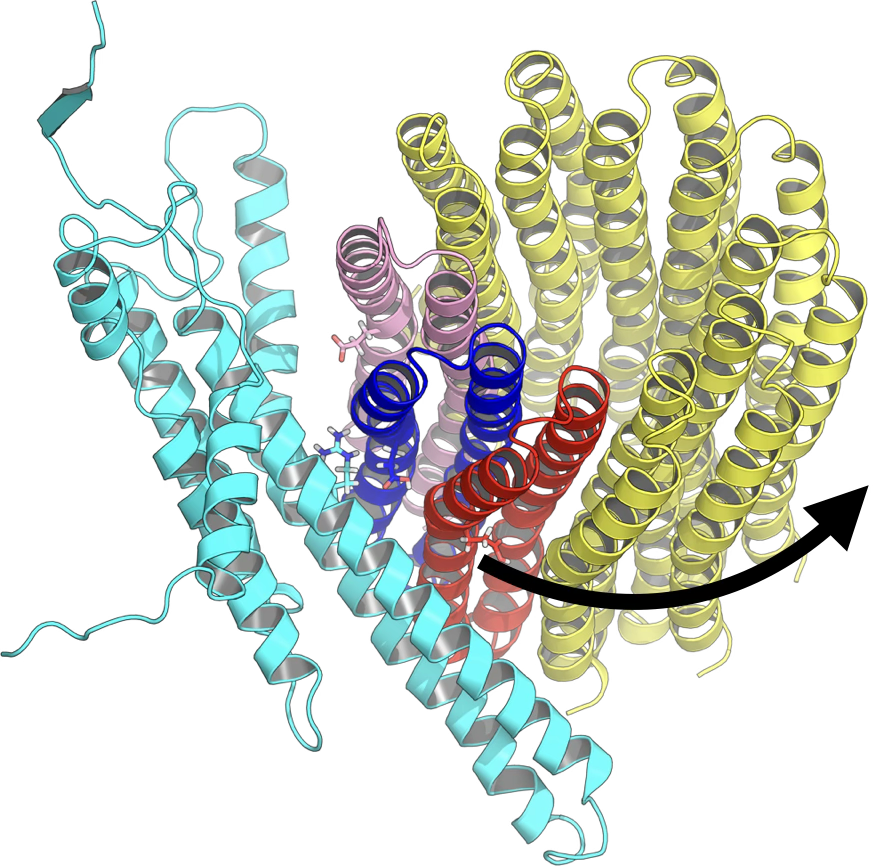
With extensive eABF calculations, we reveal the mechanism of the 36 deg rotation step of the ATP synthase rotor, clarifying the water-mediated proton transfer pathway and the role of experimentally-detected intermediates.
Proton-powered c-ring rotation in mitochondrial ATP synthase is crucial to convert the transmembrane protonmotive force into torque to drive the synthesis of adenosine triphosphate (ATP). Capitalizing on recent cryo-EM structures, we aim at a structural and energetic understanding of how functional directional rotation is achieved. We performed multi-microsecond atomistic simulations to determine the free energy profiles along the c-ring rotation angle before and after the arrival of a new proton. Our results reveal that rotation proceeds by dynamic sliding of the ring over the a-subunit surface, during which interactions with conserved polar residues stabilize distinct intermediates. Ordered water chains line up for a Grotthuss-type proton transfer in one of these intermediates. After proton transfer, a high barrier prevents backward rotation and an overall drop in free energy favors forward rotation, ensuring the directionality of c-ring rotation required for the thermodynamically disfavored ATP synthesis. The essential arginine of the a-subunit stabilizes the rotated configuration through a salt bridge with the c-ring. Overall, we describe a complete mechanism for the rotation step of the ATP synthase rotor, thereby illuminating a process critical to all life at atomic resolution.
PLOS Computational Biology, 2024
Florian E. C. Blanc (corr.), Anne Houdusse, Marco Cecchini (corr.)
PLOS Computational Biology, 2024
With eABF and the string method, we find that the recovery stroke of myosin VI is initiated by lever-arm re-priming with only weak coupling to ATPase activation.
Myosin motors use the energy of ATP to produce force and directed movement on actin by a swing of the lever-arm. ATP is hydrolysed during the off-actin re-priming transition termed recovery stroke. To provide an understanding of chemo-mechanical transduction by myosin, it is critical to determine how the reverse swing of the lever-arm and ATP hydrolysis are coupled. Previous studies concluded that the recovery stroke of myosin II is initiated by closure of the Switch II loop in the nucleotide-binding site. Recently, we proposed that the recovery stroke of myosin VI starts with the spontaneous re-priming of the converter domain to a putative pre-transition state (PTS) intermediate that precedes Switch II closing and ATPase activation. Here, we investigate the transition from the pre-recovery, post-rigor (PR) state to PTS in myosin VI using geometric free energy simulations and the string method. First, our calculations rediscover the PTS state agnostically and show that it is accessible from PR via a low free energy transition path. Second, separate path calculations using the string method illuminate the mechanism of the PR to PTS transition with atomic resolution. In this mechanism, the initiating event is a large movement of the converter/lever-arm region that triggers rearrangements in the Relay-SH1 region and the formation of the kink in the Relay helix with no coupling to the active site. Analysis of the free-energy barriers along the path suggests that the converter-initiated mechanism is much faster than the one initiated by Switch II closure, which supports the biological relevance of PTS as a major on-pathway intermediate of the recovery stroke in myosin VI. Our analysis suggests that lever-arm re-priming and ATP hydrolysis are only weakly coupled, so that the myosin recovery stroke is initiated by thermal fluctuations and stabilised by nucleotide consumption via a ratchet-like mechanism.
The Journal of Physical Chemistry Letters, 2026
Florian E. C. Blanc (corr.), Maggy Hologne, Marion Girod, Mélodie Demontrond☉, Henry Chermette, Olivier Walker (corr.)
The Journal of Physical Chemistry Letters, 2026
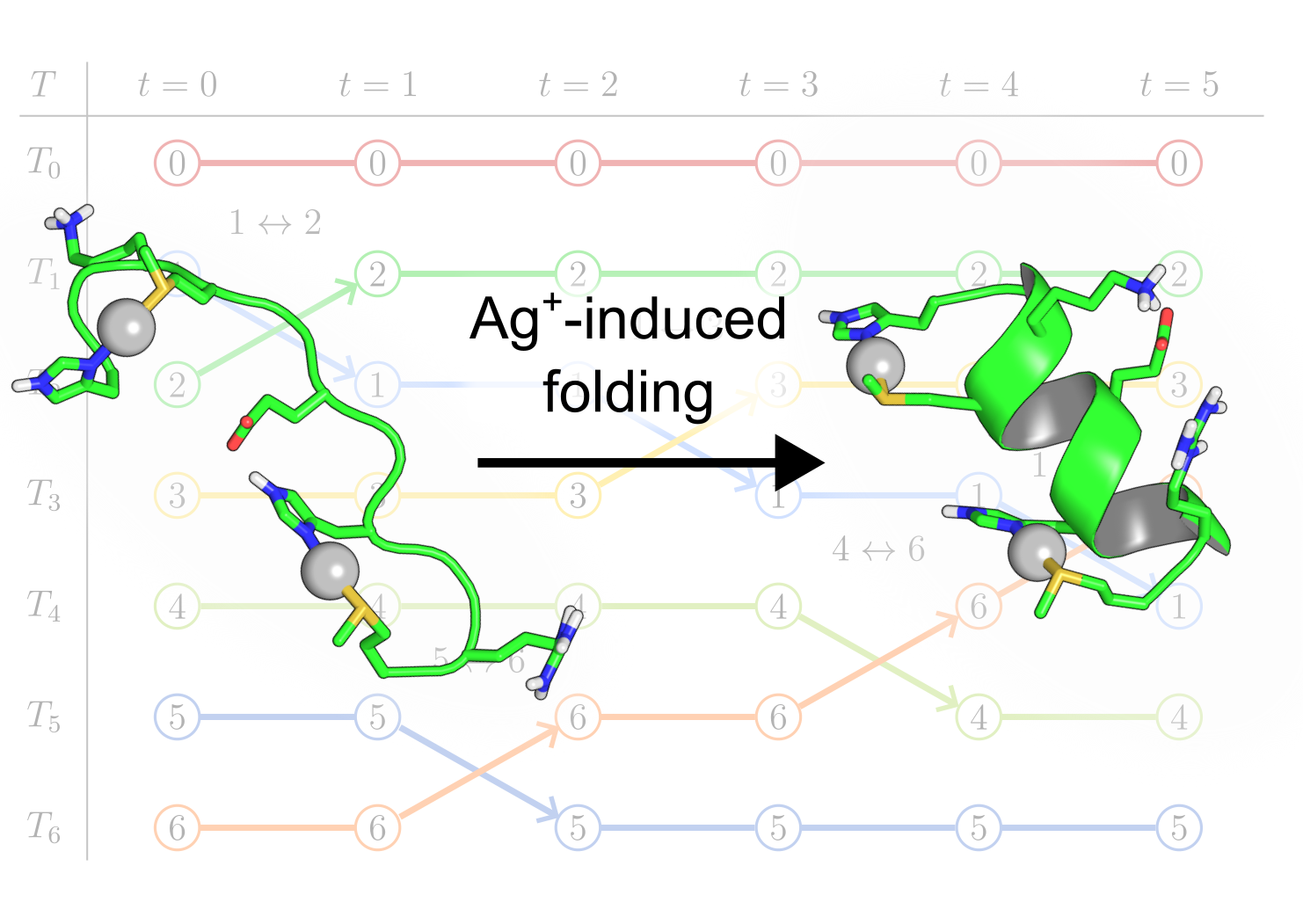
We use a custom bonded model and replica-exchange simulations to look at how Ag+ binding promotes the folding of an 11-residue peptide into an $\alpha$-helix. We train an autoencoder neural network to map the folding landscape. There is even some NMR and Mass Spec in there.
Interactions between proteins and metal cations are central to biochemical processes and shape protein structures. SilE, an intrinsically disordered protein involved in bacterial silver resistance, folds into $\alpha$-helices upon binding Ag+ ions. Focusing on the B1 peptide fragment from SilE, we investigate the mechanism of Ag+-induced folding with atomistic simulations and experiments. Guided by Mass Spectrometry and NMR, we prepare a structural model of Ag+-bound B1, which we parametrize using DFT. Then, with replica-exchange simulations and deep learning, we map B1's folding landscape and how it is shaped by Ag+. Specifically, Ag+ binding promotes folding by lowering the entropy of the disordered state and stabilizing the folded state. We also describe how Ag+ alters the folding pathways. Overall, we improve our understanding of metal-induced protein folding and lay the groundwork for further computational investigations of the bacterial silver-resistance machinery.
ACS Omega, 2026
Laura Troussicot, Florian E. C. Blanc, Yoann Pascal, Sebastien Vidal, Jean-Marc Lancelin, Florence Guillière
ACS Omega, 2026
In this drug design project, we combine funnel metadynamics, NMR and biochemical assays to improve an inhbitor of Human peroxiredoxin 5, a target enzyme for innovative treatments against strokes.
Abstract Using insights from funnel metadynamics, a molecular dynamics protocol that provides a detailed representation of protein--ligand interactions, we investigated how a single heavy-atom modification can enhance the activity of an initial hit against human peroxiredoxin 5. This improvement was validated by NMR experiments and enzyme-inhibition assays. Our results illustrate how molecular dynamics simulations offer a rational framework for designing ligands with improved properties, starting from low affinity but selective hits with minimal structural modifications.
Mentoring, TalENS (ENS student association for high-school student mentoring), 2010
Graduate course, Institut Supérieur des BioSciences (ISBS), 2014
Graduate course, Université de Strasbourg, 2016
Undergraduate course, Université de Strasbourg, 2017
Elementary calculus, linear algebra, Euclidean geometry, trigonometry, probabilities and statistics.
Graduate course, Goethe University Frankfurt, 2021
Guest lecture, Master 1 Chemistry, Université Claude Bernard Lyon 1, 2025
Guest lecture, Master 1 Chemistry, Université Claude Bernard Lyon 1, 2026


